

March 10, 2023 ● 11 min read
Profit and Loss Statement for Amazon Sellers










You may have agreed with the advice that monitoring your Amazon click-through rate (CTR) is vital, but what’s the reasoning behind this?
Keeping tabs on your Amazon click-through rate helps you gain insights into your ad performance and measure user engagement.
Move on to find out how your CTR can empower you to assess the relevance of your ads to potential customers and ascertain whether adjustments to your ad campaigns are necessary to enhance their effectiveness.
Amazon PPC CTR is a ‘Click-Through Rate’ in the context of Amazon advertising Pay-Per-Click (PPC). It measures your ad’s effectiveness at getting people to click.
Simply put, CTR on Amazon tells you the percentage of people who saw your ad and then decided to click on it. It can also be called a popularity gauge for your ad. The higher the CTR, the more attractive and relevant your ad appears to shoppers.
So, if you have a high CTR, it means more people are interested in what your ad is offering. If you get a low CTR, it might be a sign that you must make your ad more appealing to potential customers.
A CTR of 0.5% or higher is considered good, while rates below 0.3% stand for consistently low CTR and need some improvement. According to the updated data of 2023, the average CTR for Amazon ads is around 0.35%.
Here’s why your Click-through rate is important on Amazon:
CTR directly influences the visibility of your products in Amazon’s search results. When more shoppers click on your listing, Amazon’s algorithm recognizes it as relevant and valuable, leading to better rankings. Higher rankings mean more exposure to potential buyers.
Amazon is a highly competitive marketplace, with numerous sellers offering similar products. A high CTR sets your product apart and signals to Amazon that your listing is resonating with shoppers, giving you an edge over competitors.
If you’re running Sponsored Product Ads, a strong CTR leads to better ad performance. Amazon rewards ads with high CTRs by lowering the cost-per-click (CPC) and increasing ad visibility, which ultimately saves you money while driving more traffic.
To determine your CTR quickly and easily, use the following formula:
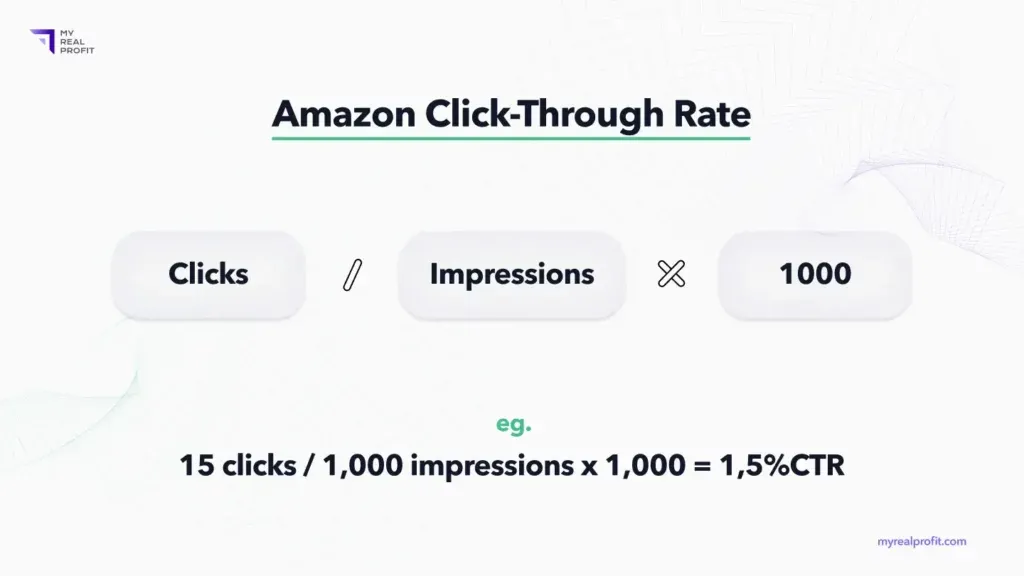
Here’s what each component is about:
Clicks mean the number of times shoppers click on your Amazon ad. It directly measures how many people have shown interest in your ad by clicking on it.
Impressions are the total number of times your ad is displayed to Amazon shoppers, regardless of whether they click on it. Impressions represent how often potential customers see your ad.
The professional tool myrealprofit.com is another way to view your Amazon click-through rate. This analytics ecosystem gives you an in-depth analysis of your Amazon advertisement’s performance, pinpointing the areas for improvement and providing actionable insights to increase your sales. With this data, you can create effective strategies to optimize your CTR and maximize your profits on Amazon.
There are three main types of ads on Amazon – Sponsored Products (SP), Sponsored Brands (SB), and Sponsored Display (SD). Each type of ad serves a unique purpose and has a distinct impact on your CTR.
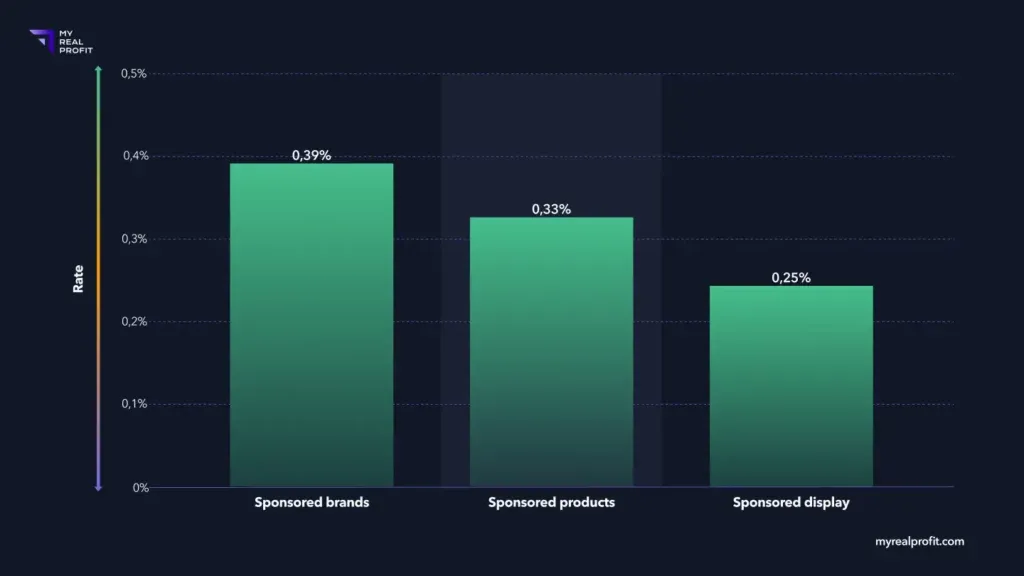
Sponsored Brands (SB) ads are designed to increase brand awareness. These ads appear at the top of Amazon search results, showcasing your brand and a selection of your product range.
The median CTR for this ad type is 0.39%, which is a higher CTR compared to other types of Amazon advertisements. Also, SB are essential for brand exposure and can lead to increased loyalty and repeat purchases over time.
These are cost-per-click (CPC) ads that promote individual product listings on Amazon. SP appear on the search page and product detail pages, helping to increase the visibility and sales of your products. The reason is SP directly targets shoppers who are already in the buying process.
Sponsored Display (SD) ads are a form of display advertising that targets shoppers who have previously viewed your products or similar items.
These ads appear on product detail pages, customer review pages, and below the search results. Despite having a lower CTR, SD ads are effective for retargeting, helping you reconnect with shoppers and encouraging them to purchase.
Here are the most common factors that can cause a low CTR on Amazon.
If your ad placement is in areas with low visibility or not related to the products you’re selling, your CTR will likely suffer as a result. Ensure you’re targeting the right category and audience to maximize your ad exposure.
Outdated keywords can hurt your CTR as they won’t be relevant to people searching for products on Amazon. Regularly update and incorporate relevant keywords more likely to attract potential customers.
If your ad campaign is targeting the wrong audience or isn’t related to your product, it won’t be able to generate clicks and sales. Use negative keywords to narrow down your target audience and create ads that are relevant to the product you’re selling.
Improving your click-through rate on Amazon requires understanding how it works and taking the right strategies. So, we gathered some tips to help you increase your click-through rates.
You must target the most relevant keywords if you want a high CTR for your items. Ensure your keyword list includes short and long-tail keywords related to your product and likely to attract visitors. Remember to negative keywords, which can help eliminate unqualified traffic and reduce advertising costs.
Do you know which relevant keywords to use? Research popular terms shoppers use or try a professional tool like My Real Profit with its automated Keyword Tool.
Get more traffic by optimizing your product listing. Crafting a captivating product title enriched with relevant keywords not only improves visibility but also entices clicks. High-quality images, including lifestyle photos, highlight your product’s features, boosting its appeal. Add an eye-catching main image, an image title that perfectly summarizes the key details of your product, and other vital information that is clearly visible and easy to access.
You need to monitor and test your ad campaigns constantly. You should keep an eye on the performance of each campaign and adjust them accordingly. Use the A/B testing feature to try different variations of sponsored ads and find the one that works best for your product.
A lower CTR doesn’t always indicate an unappealing product. It may be due to Amazon’s algorithm placing your ad incorrectly, considering factors like relevance, bid, and user behavior. Inappropriate audience targeting or low-visibility positions can harm CTR. Optimize ad placement through testing and monitoring for better results.
Another way to increase your click-through rate on Amazon is to encourage shoppers to leave more positive reviews. Positive reviews build trust with shoppers and position your product as the best buying option. Reviews are an essential factor affecting buyer decisions and can help boost your CTR. The more positive feedback you get, the higher your CTR will be.
Encourage satisfied buyers to leave reviews by including a request in follow-up emails or packaging inserts. Actively engage with customer feedback, responding to both positive and negative reviews to demonstrate your commitment to customer satisfaction and build trust.
Pricing is one of the most important factors to consider when improving your CTR. Shoppers want to get value for their money, so they’ll be more attracted to fairly priced products. Displaying discounts, promotions, and deals prominently on your listing can make your product stand out. Amazon’s “Subscribe and Save” program can also entice recurring customers. You can use a price monitoring tool to check your competitors’ prices and adjust yours accordingly.
A+ Content, formerly known as Enhanced Brand Content (EBC), provides a valuable opportunity to expand upon your product’s details with additional images, infographics, and engaging descriptions. Utilize this feature to tell your brand story, highlight unique features, and provide a more immersive shopping experience for your customers.
Finally, you can look up some insights from other Amazon sellers. Analyze their ads and see what they do differently. What keywords are they using? How often do they update their ads? Which ad placements are working best for them? Understanding your competitors’ strategies can help you optimize your campaigns and improve your click-through rates.
So, boosting your click-through rates is about fine-tuning your approach. From savvy keyword management to persuasive product descriptions, these strategies can turn browsers into regular shoppers!
A good CTR directly impacts the visibility and ranking of your Amazon listing. A higher CTR indicates that more people find the product appealing and are likely to make a purchase.
Focus on optimizing your product listings with relevant keywords, high-quality images, and compelling content. Also, remember to encourage customers to leave positive reviews.
Yes, external factors such as market trends, seasonal variations, or competitor actions can affect your Amazon click-through rate. Track such data using SQP and Category Insights reports. Using such data, you will be able to adjust your product listings and promotions based on seasonality and analyze competitor strategies to address this.
To get a higher CTR, aim to refresh your content every few months or as needed, especially when there are changes in product features, customer preferences, or market trends.