

October 23, 2026 ● 10 min read
What Is an Amazon Fulfillment Center?










Amazon seller reports are the files and dashboards Seller Central keeps about your account. They hold most of the information Amazon gives sellers: sales, traffic, payments, stock, ads, returns and, if you own a brand, search and customer data.
The catch is that they sit in different menus. This guide puts them in one place.
| Report category | What it shows | Section in this guide | Best for |
|---|---|---|---|
| Business Reports | Sales, units, page views, sessions, Buy Box percentage | Business Reports | Daily sales and traffic checks |
| Payments | Settlements, transactions, fees, deposits | Payments reports | Cash flow and monthly reconciliation |
| Fulfillment (FBA) | Stock, stranded and aged units, removals, reimbursements, storage fees | Amazon FBA reports | Inventory health and fee control |
| Orders | Every order with its status and items | Order reports | Order-level checks and exports |
| Returns | Returned units, return reasons, condition | Return reports | Spotting product and listing problems |
| Advertising | Search terms, targets, placements, ad spend and sales | Advertising reports | PPC optimization |
| Brand Analytics | Search queries, search terms, repeat purchases, baskets | Brand Analytics reports | Brand owners researching demand |
| Account Health | Policy compliance and performance metrics | Account Health | Protecting the account |
Amazon reports for sellers are Amazon’s record of everything that happens in your account. So what information does Amazon give sellers? Every order, refund, fee, ad click and stock movement lands in one of these reports, and you can open most of them on screen or download them.
You’ll use them for four questions. Are sales growing? Do you make money after Amazon’s fees? Is any stock stuck or getting old? Are the ads paying off?
No single report answers all four.
They also catch problems early. A missing reimbursement or a sudden drop in sessions shows up in a report long before you notice it in your bank account.

Most Seller Central reports live under Reports in the main menu: Payments, Business Reports, Fulfillment, Custom Reports and Tax Document Library.
Two groups live somewhere else:
No Reports tab? You are probably signed in as a secondary user without access to those reports. Ask the account owner or an administrator to give you View or View & Edit access to those reports in Settings > User Permissions.
A few files, like the 1099-K tax form, open only for the primary user.
Each group gets a short table and a note on what its reports leave out. Click paths are all in one place, in the download section.
Amazon Business Reports are where you go for sales and traffic. Amazon keeps up to two years of data here, and every report downloads as a CSV file.
| Report | What it shows | Data retention and refresh |
|---|---|---|
| Sales Dashboard | Today’s sales against yesterday, the same day last week and last year | Up to two years |
| Sales and Traffic by Date | Ordered product sales, units, page views, sessions and conversion by date | Up to two years, updates hourly |
| Detail Page Sales and Traffic by ASIN | The same metrics per parent ASIN, child ASIN or SKU, plus Buy Box percentage | Up to two years, updates daily |
Limitations: you won’t find fees, costs or profit here. Sales count on the day of the order, so later refunds stay in the total.
Payments reports follow the money: what Amazon collected, what it charged you and what it paid out. The statements work as your Amazon Seller Central monthly reports for bookkeeping.
| Report | What it shows | Data retention and refresh |
|---|---|---|
| Payments Dashboard | Your balance and the next payout | A live summary, not a history |
| Transaction View | Each order, refund, fee and adjustment as it is posted | Last 24 months, up to the previous day |
| Statement View (All Statements) | One statement per settlement period | A new statement about every 14 days |
| Date Range Reports | A summary or a transaction file for any date range you choose | Up to 365 days per report, going back to 2012 |
| Settlement / Disbursement report | Every transaction in one payout, with its settlement period | Created by Amazon for each payout; you can’t request one |
Limitations: product cost and ad spend per product are missing. Settlement periods also ignore calendar months, so pull a Date Range Report when you need a clean monthly total.
FBA reports cover the stock you keep in an Amazon fulfillment center. They show what’s there, what’s stuck and what storage costs you.
| Report | What it shows | Data retention and refresh |
|---|---|---|
| Inventory / Manage FBA Inventory | Active inventory with condition, quantity and volume | Near real time (at most every 30 minutes) |
| Inventory Health | Aged and excess units, estimated storage and long-term storage fees | Generated when you request it |
| Stranded Inventory | Units in stranded status, with a recommended action for each | Near real time |
| Removals | Every removal order and the items in it | Near real time |
| Reimbursements | Each reimbursement and its reason | Daily |
| Storage Fees | Estimated monthly storage fee per ASIN | Monthly estimate |
| Amazon Fulfilled Shipments | Shipped FBA orders | One month of data per request |
Limitations: every report is its own file on one topic. If you want stock, fees and sales speed side by side, you’ll be joining spreadsheets.
All Orders lists every order, whatever the channel or shipping status, by order date or by last update. Unshipped Orders keeps only the ones not yet confirmed as shipped.
| Report | What it shows | Data retention and refresh |
|---|---|---|
| All Orders | Every order with its items, status and channel | Orders less than two years old, 30 days per request |
| Unshipped Orders | Orders not yet confirmed as shipped | Covers the last 38 days |
Limitations: you get order values, not fees or payouts. Cancelled orders show up in All Orders with their status.
FBA Customer Returns lists items that came back to an Amazon fulfillment center, with the return reason and the disposition (the condition Amazon recorded). Orders you ship yourself have their own return reports, up to 60 days per request.
| Report | What it shows | Data retention and refresh |
|---|---|---|
| FBA Customer Returns | Returned units, return reason and disposition | Updated daily |
| Seller-fulfilled returns | Return requests for orders you ship yourself | 60 days per request |
Limitations: the report has no return rate. You divide returned units by units sold from Business Reports yourself, product by product, or let Amazon returns analytics tools do it.
Ad reports come from the Amazon Ads console. For Sponsored Products, Amazon lists these:
| Report | What it shows | Data retention and refresh |
|---|---|---|
| Search term | The searches that triggered your ads and which ones converted | A few months of history |
| Targeting | How each keyword or product target performs | A few months of history |
| Advertised product | Results for each advertised product over time | A few months of history |
| Purchased product | What shoppers bought after clicking your ads | A few months of history |
| Placement | Results by placement, such as top of search | A few months of history |
| Campaign / performance over time | Spend, clicks and average cost per click over time | A few months of history |
Amazon keeps ad report data for a few months only, and the window differs by report, so download what you want to keep. Sponsored Display has its own set of campaign, targeting, advertised product and purchased product reports. Before you judge the numbers, read our guide: what is ACoS in Amazon.
Limitations: ad reports know your ad sales, not your profit. Without product cost in the picture, a low ACoS can still lose money.
You need a Professional selling plan and the Brand Representative role for a brand in Amazon Brand Registry. Amazon says the data generally goes back three years and usually arrives within three days.
| Report | What it shows | Data retention and refresh |
|---|---|---|
| Search Query Performance | Impressions, clicks, add to carts and purchases for the searches that lead to your brand | About three years, ready in about three days |
| Top Search Terms | The most searched terms and the products clicked for them | About three years |
| Market Basket Analysis | Products bought together with yours | About three years |
| Repeat Purchase Behavior | How many customers buy your products again | About three years |
| Demographics | Who your buyers are, by profile group (US store only) | About three years |
Start with the Amazon Search Query Performance report.
Limitations: it’s brand data, with nothing on your profit. Demographics also skips ASINs with fewer than 100 unique customers in the chosen period.
Older guides mention an “Account Activity” report, a date range summary of your payments. When sellers asked about it on the Amazon Seller Forums, Amazon staff said the formats have changed and pointed to the Payments reports instead.
For the old summary, run a Date Range Report summary for the period.
Account Health is a separate page with your Account Health Rating (0 to 1,000), policy issues and shipping and customer service metrics. Anything from 200 up counts as healthy. Amazon also expects your Order Defect Rate to stay below 1%.
Limitations: it tells you whether the account is at risk, not how the business is doing. For sales and payouts, go back to Business Reports and Payments.
Custom Reports, in the Reports menu, let you build a report from the fields you choose and save it as a view, for example a custom inventory report.
The Tax Document Library keeps your tax forms by year, including Form 1099-K for US sellers who pass Amazon’s threshold. You also generate the Sales Tax report here, and only the primary user can open it.
Limitations: these are tax forms, not bookkeeping data, so fees, payouts and profit by product are not here.
Business Reports download as CSV files. Some reports cap how much you get per request: 30 days for All Orders, one month for Amazon Fulfilled Shipments, 60 days for seller-fulfilled returns, 365 days for a Payments Date Range Report.
Most reports open on screen first, with a download or request button.
The quickest way:
You get ordered product sales and units. For sales after refunds and fees, use a Date Range Report from Payments instead.

Keep the checks short by giving each report a rhythm:
Your Amazon sales reports can show three different totals for the same month, and all three are right. They just count at different moments.
Business Reports count a sale on the day of the order. Payments count it when the transaction posts to your account, usually after the order ships, and a refund shows up there on the day it’s processed, sometimes weeks later. Ad spend lives in the Amazon Ads console and reaches Payments as its own charge.
Say you sell $10,000 in the last week of March. Business Reports put all of it in March. Part of the money settles in early April, so your March statement comes out lower.
Then a $500 refund arrives in April for a March order. It lowers April’s payout, yet March in Business Reports still says $10,000.
Use order date for sales trends and settlement date for cash, and the numbers stop fighting.
Seller Central reports are free and detailed. They also have gaps:
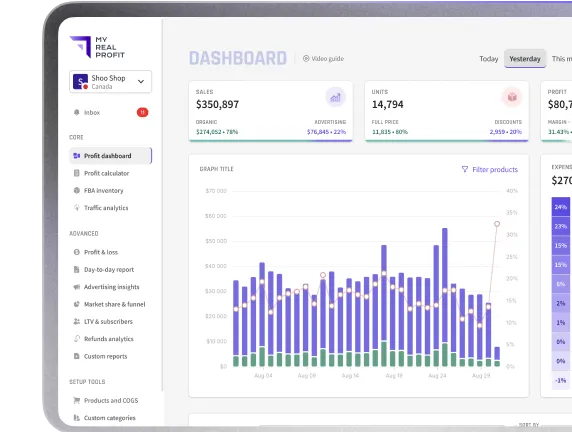
Tools that do Amazon analytics for sellers, such as My Real Profit, pull these reports through Amazon’s APIs and join them for you. Its Amazon profit dashboard shows sales and profit in one view, refreshed every 30 minutes.
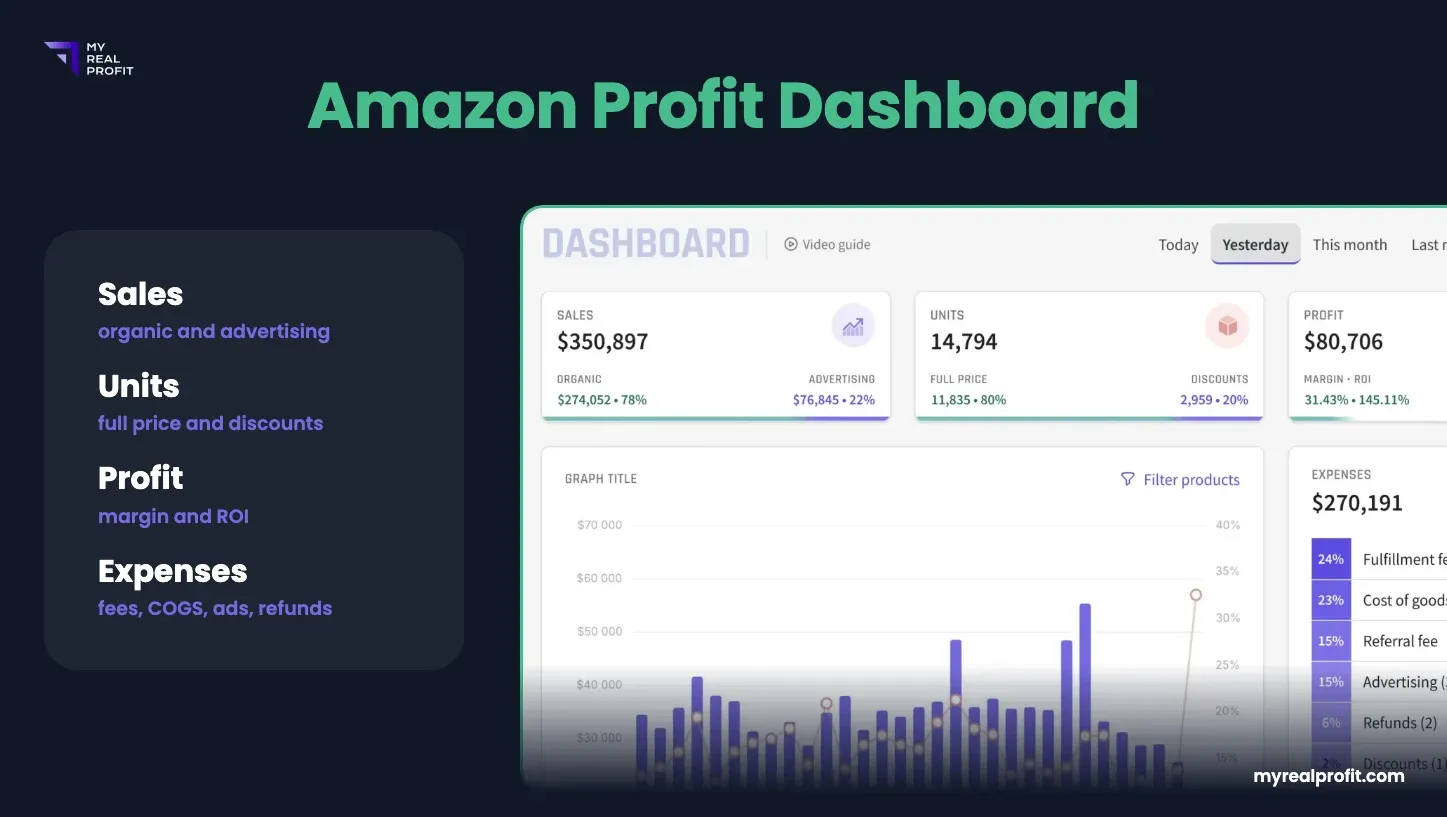
The Profit and Loss report breaks every cost down by month, week, day or product. FBA Inventory shows stock by status with days of coverage. Refunds Analytics tracks the refund rate and return reasons, by order date or by refund date.
It has limits too. You enter your product costs (COGS) yourself, and storage fees are estimates, because Amazon shows the real charge about a month and a half later. The trial is free for 21 days, with no credit card.
It depends on the report. Business Reports keep up to two years and Brand Analytics about three, while order reports cover orders less than two years old. For Payments and ads, see their sections above.
Yes. The Selling Partner API (SP-API) has a Reports API for most Seller Central reports, and the Amazon Ads API handles ad reports. Settlement reports are the exception: Amazon creates them on its own schedule, so you can read them but not request them.
None of them. Payments shows what you were paid after Amazon’s fees, but your product cost and ad spend per product are missing. The section on when Seller Central reporting isn’t enough covers the fix.
Business Reports by date update hourly and the rest daily. Near real-time FBA reports refresh at most every 30 minutes, and Brand Analytics usually lags about three days. Each table in the report types section lists the refresh.
Yes, plus a Professional selling plan and the Brand Representative role for your brand. Without them, you can’t open Brand Analytics.