


June 28, 2023 ● 9 min read
Amazon Seller Reports Guide: All Reports Explained With Links









The Amazon marketplace doesn’t offer a single business type. It is an ecosystem of different Amazon business models, each with its own economics, risks, and scaling potential.
Many sellers enter Amazon without clearly defining which model they are building. As a result, they optimize tactics instead of strategy, focusing on listings, ads, or products without understanding how their business is supposed to scale.
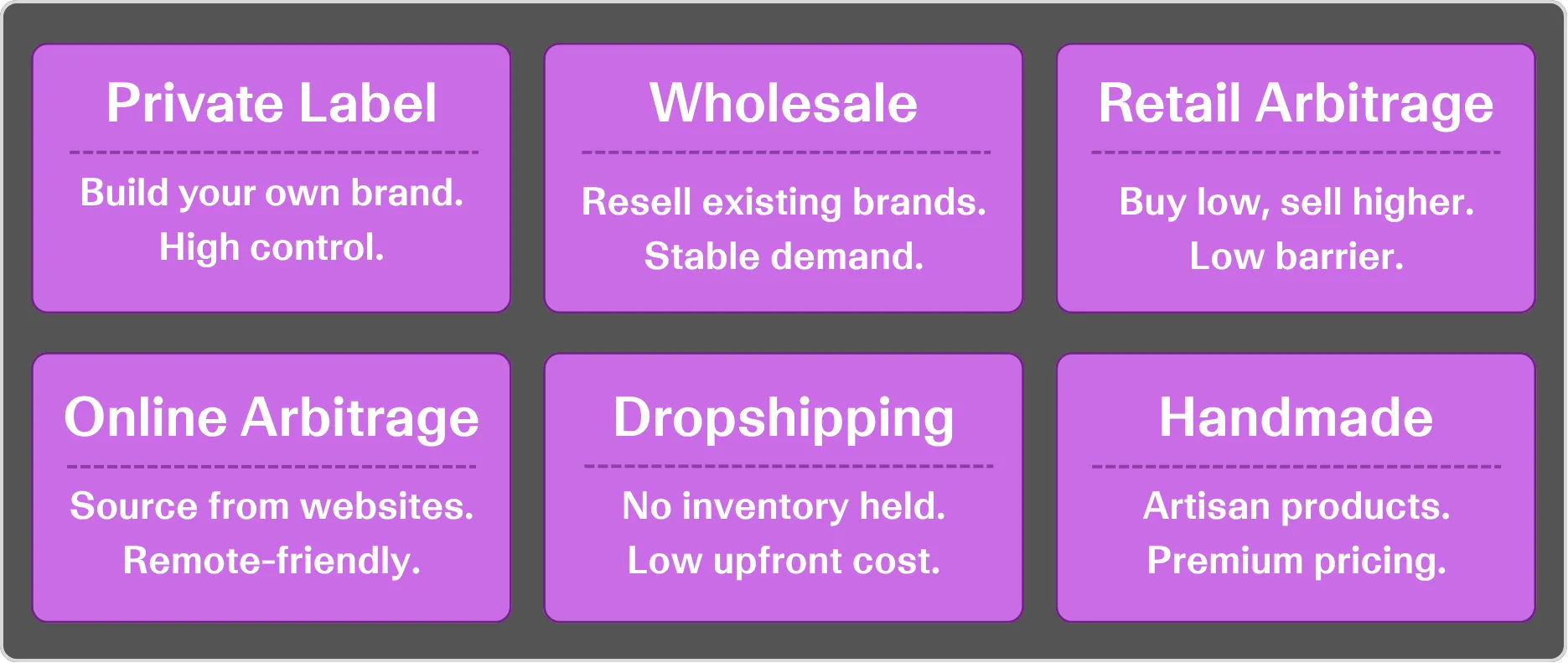
The most common Amazon business models include:
Each model operates differently and leads to a different type of business. Choosing the right one is not just an operational decision. It directly impacts:
In this guide, we’ll break down the core Amazon business models, compare their trade-offs, and explain how to choose a model that supports a scalable Amazon business.
Two sellers can generate the same revenue on Amazon and have completely different outcomes.
The difference is not execution. It is the underlying model.
Each model defines:
This is why selecting the right model is one of the most important Amazon selling strategies. But which one is right for you, and what does it actually take to make each one work? We break down each model in detail below.
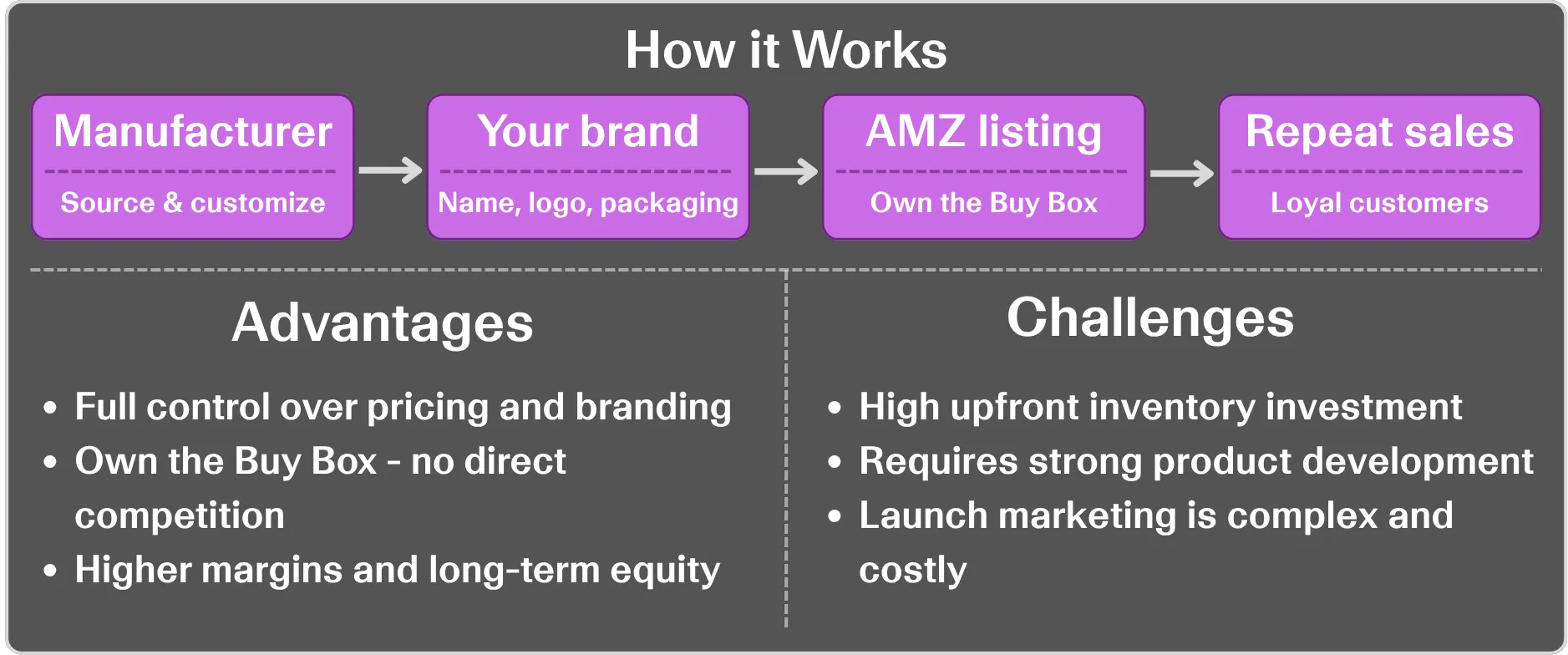
Private label is the most common model for sellers focused on long-term growth because it allows you to build a business around your own brand rather than relying on someone else’s.
In this model, you create a unique brand identity, work with manufacturers to source or customize products, and sell those products under your own brand name. This gives you more control over pricing, marketing, product quality, and customer experience, which is why many sellers spend so much time improving Amazon listing content for performance.
Private label is one of the few models that allows you to build a truly scalable Amazon business.
Key advantages:
Unlike reselling models, you are not competing with other sellers on the same listing.
Private label requires strong execution across multiple areas:
It also requires a higher upfront investment due to:
Private label works best when:
This model is ideal for sellers who are thinking beyond quick wins and want to create a business with lasting value. Over time, a private label can lead to stronger customer loyalty, repeat purchases, and a more defensible business, especially for brands that are protected through Amazon Brand Registry.
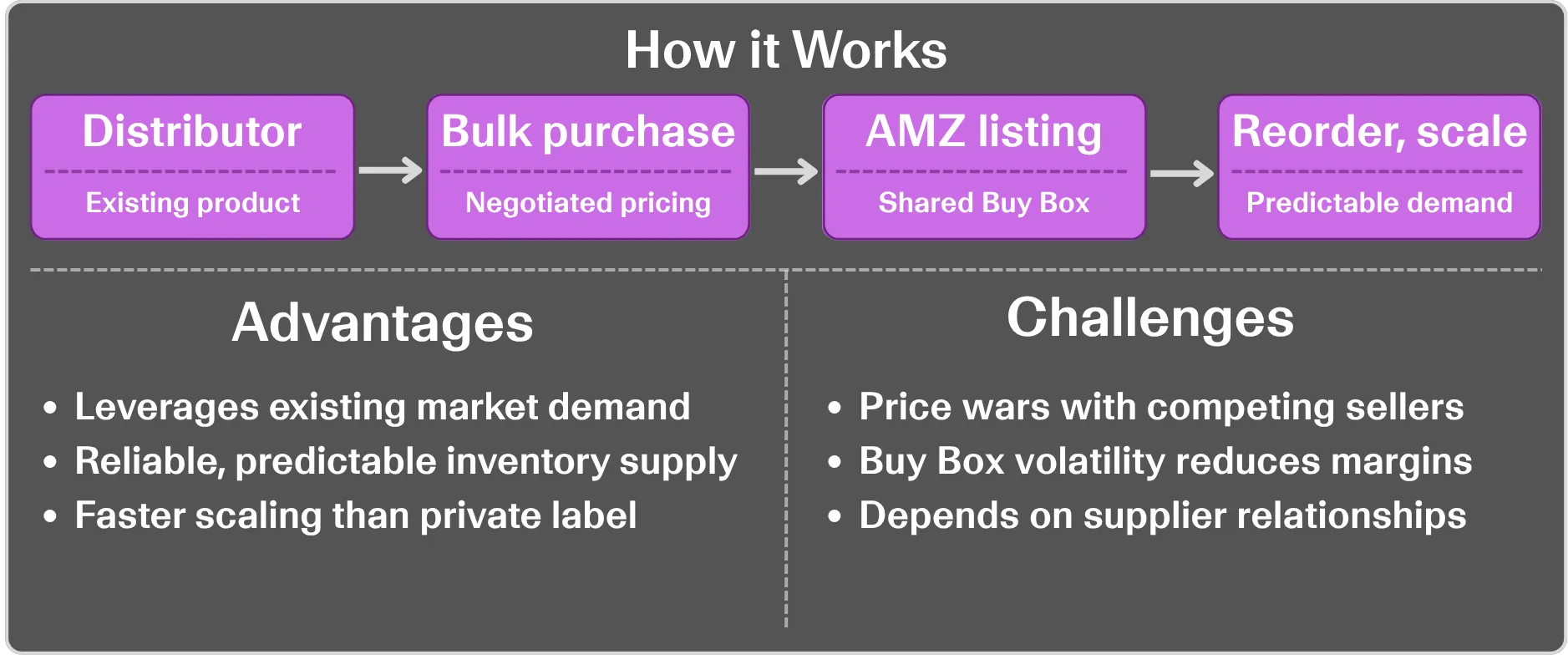
Wholesale involves buying products in bulk from brands or distributors and reselling them on Amazon. Instead of creating your own product, you sell items that already exist and already have market demand. This model can be attractive because it allows sellers to grow faster without having to build a brand from scratch. It is often a good fit for those who want a more straightforward path to selling, while still benefiting from established products and customer demand.
Wholesale is one of the more stable Amazon business models because it relies on existing demand.
Key advantages:
You are not creating demand, you are leveraging it.
The main limitation is competition.
Multiple sellers often list the same product, which leads to:
Wholesale works best when:
This model is often a strong fit for sellers who want to focus on operations, inventory management, and consistent execution rather than building a brand from the ground up. Over time, it can become a dependable model for sellers who value predictability and process, particularly when they understand fulfillment decisions like Amazon FBA vs FBM.
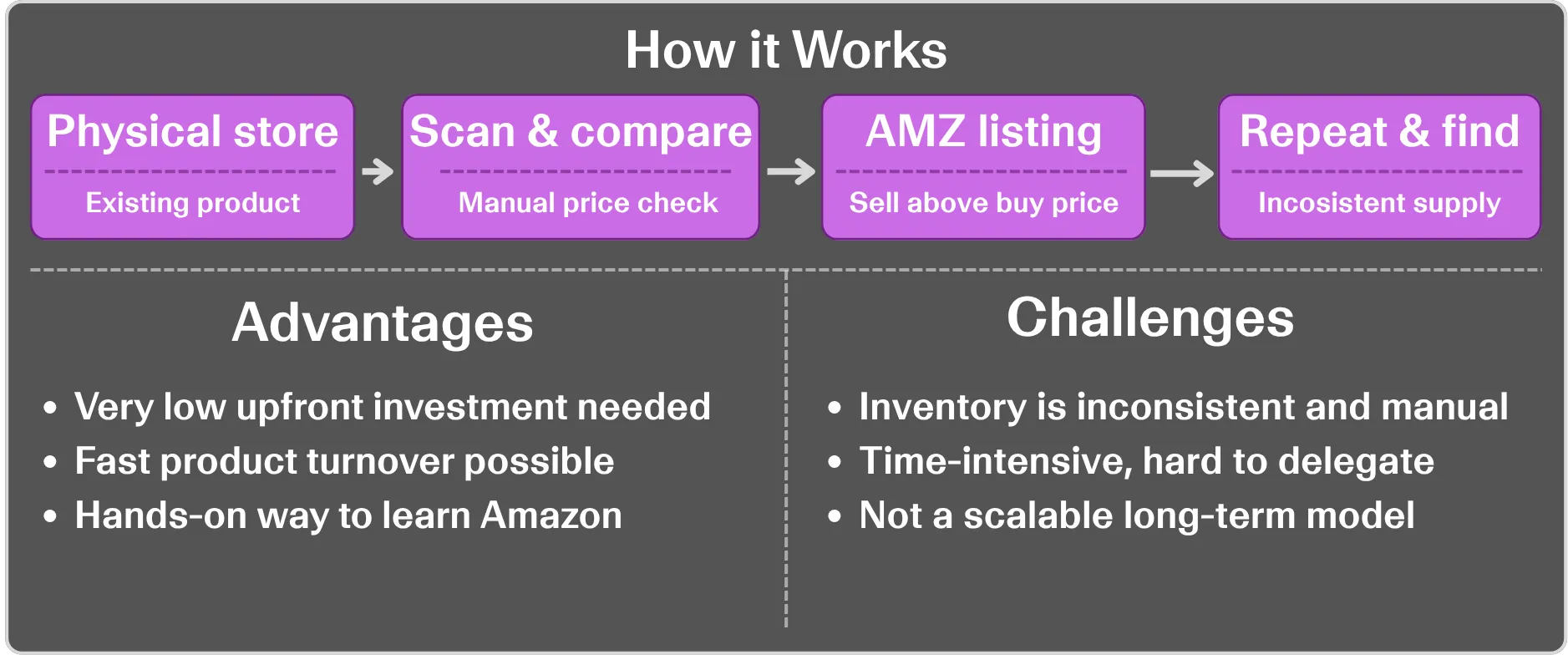
Retail arbitrage involves buying discounted products from physical stores and reselling them on Amazon. Sellers typically look for clearance items, in-store deals, or underpriced inventory that can be sold online for a profit. This model is often popular with beginners because it has a relatively low barrier to entry and does not require creating a brand or ordering large amounts of inventory upfront.
It has one of the lowest barriers to entry among Amazon business models.
Key advantages:
Retail arbitrage is difficult to scale because:
Retail arbitrage is often used as:
It can be a useful entry point for new sellers who want hands-on experience with sourcing, pricing, and fulfillment. However, it is not typically considered a scalable Amazon business model, since growth often depends on constantly finding new deals and repeating a manual process.
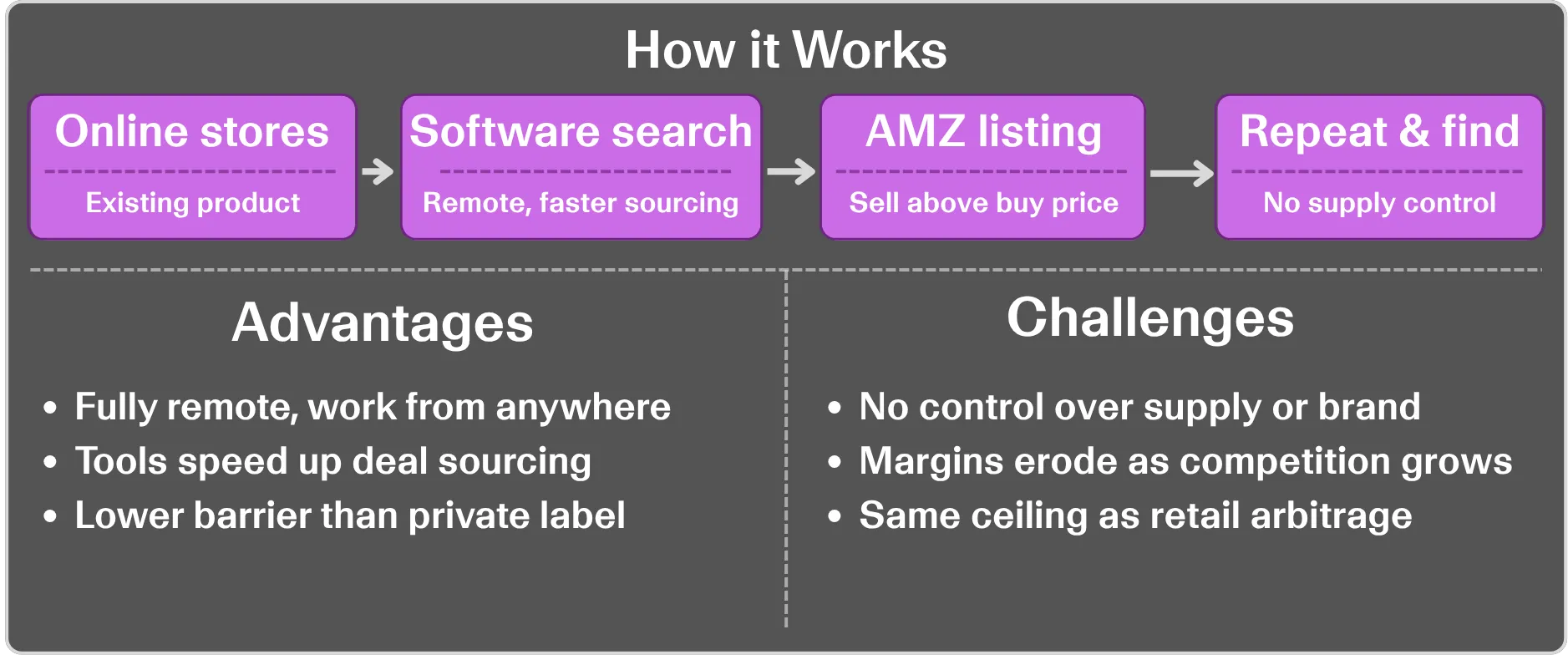
Online arbitrage follows the same logic as retail arbitrage but uses online sources instead of physical stores. Instead of visiting retail locations in person, sellers search websites, marketplaces, and online clearance deals to find products they can resell on Amazon for a profit.
This model offers more flexibility and can often be managed from anywhere, making it appealing to sellers who prefer remote sourcing. It is commonly used by those who want a lower-barrier way to start selling while gaining experience with product research, pricing, and inventory decisions.
Online arbitrage improves efficiency, but it does not fundamentally change the business model. Sellers may be able to source faster, work remotely, and scan more opportunities than they could with retail arbitrage, but the model still depends on finding price gaps and acting on them quickly, which makes tracking Amazon KPIs more important over time.
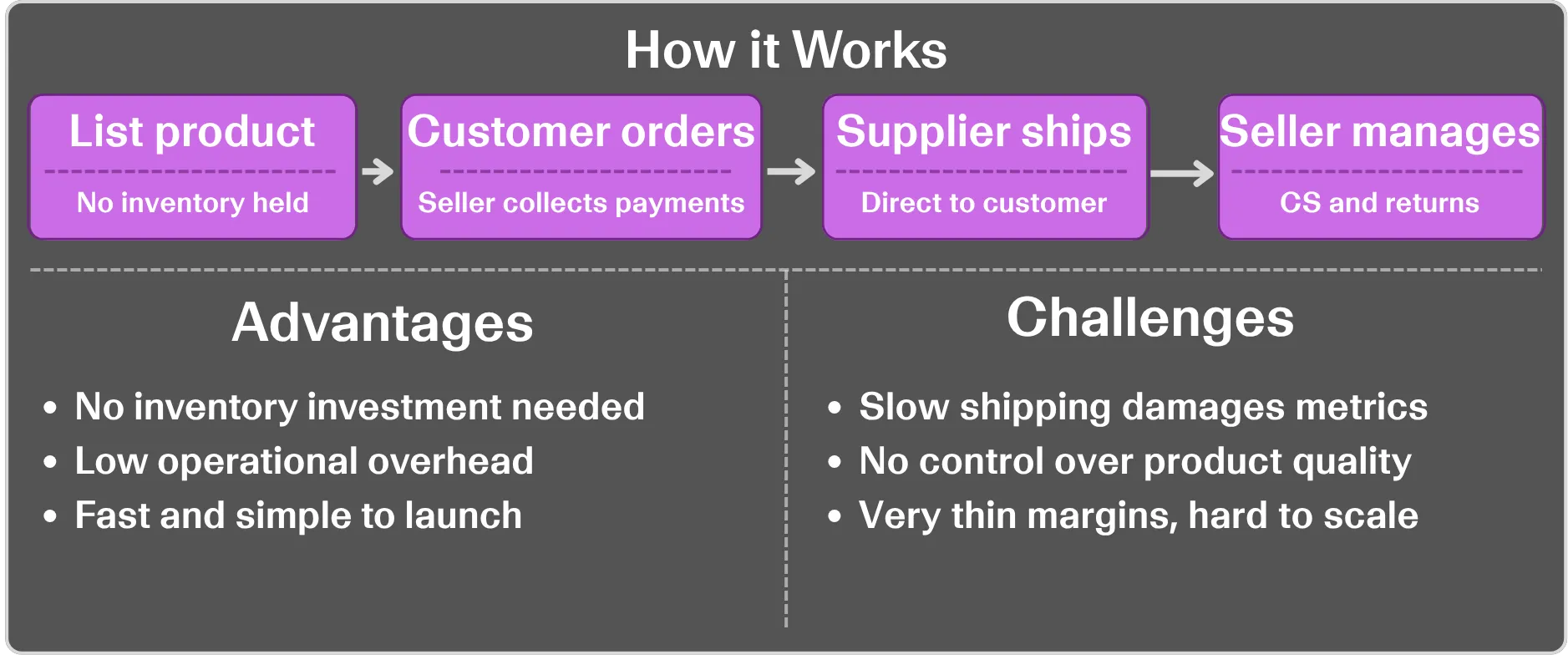
In dropshipping, you list products without holding inventory. When an order is placed, the supplier fulfills it. This means you do not need to buy inventory upfront or manage storage yourself, which can make the model appealing for sellers looking to start with lower initial costs.
The main appeal is low risk.
Key advantages:
Amazon is optimized for:
Dropshipping often struggles with:
Dropshipping is one of the least reliable Amazon selling strategies for long-term growth. While it can seem attractive because it requires little upfront inventory investment, sellers often have limited control over fulfillment speed, product quality, and stock availability. That lack of control can create customer service issues and make it harder to build a stable, defensible business over time.
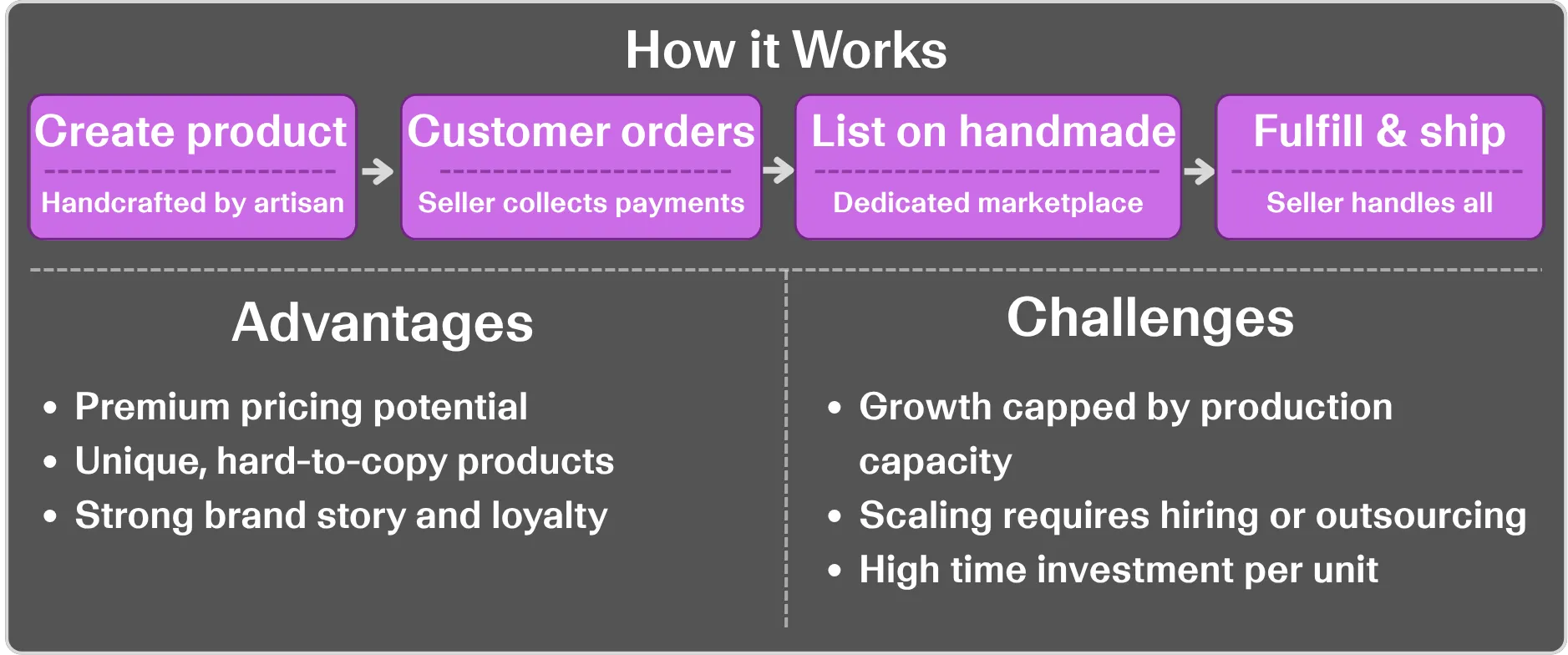
Amazon Handmade is designed for artisans selling handcrafted products. It gives makers a dedicated marketplace to reach customers who value originality, craftsmanship, and small-batch production. It can be a strong option for creators who want to turn handmade work into an online business while keeping the brand closely tied to the product itself.
Handmade is a strong niche model but not designed for large-scale operations. It works best for sellers who value craftsmanship, uniqueness, and brand story over volume and speed. While it can create loyal customers and strong product differentiation, growth is often limited by production capacity and the hands-on nature of the business.
Choosing between Amazon business models should be a strategic decision based on your constraints and goals. Each model comes with different trade-offs in terms of scalability, control, margins, and long-term value. The best choice is usually the one that aligns most closely with your resources, strengths, and business objectives.
Different models require different levels of investment:
Some models require active involvement:
If your goal is long-term growth, scalability becomes the most important factor.
Control determines how much influence you have over your business:
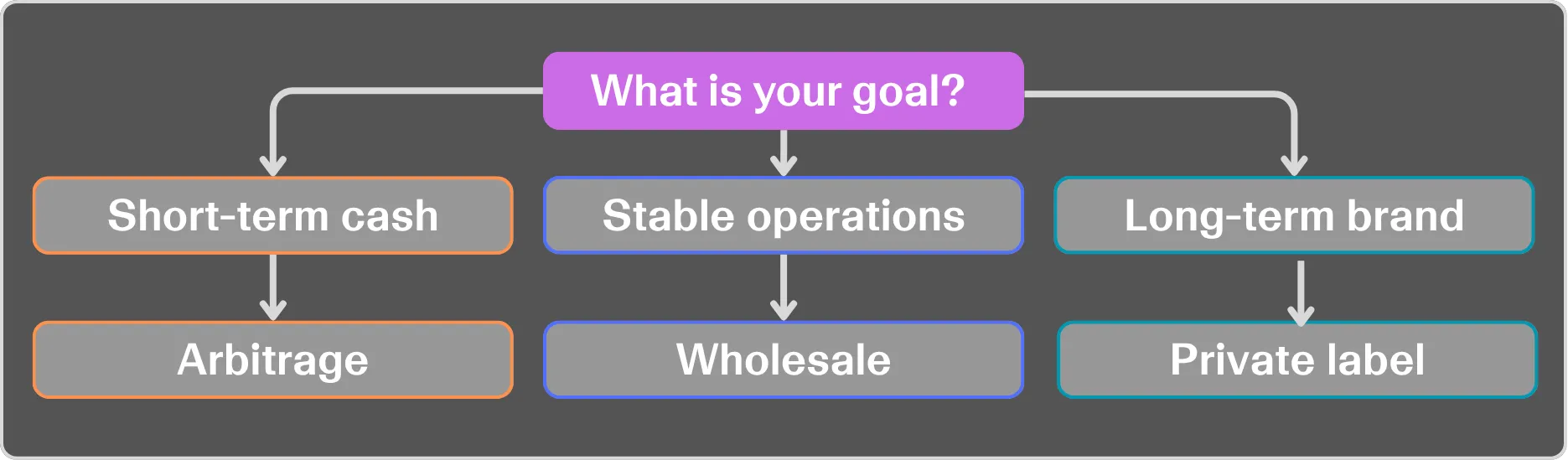
There is no universal “best” model. The right choice depends on what you are optimizing for. Some sellers prioritize long-term brand value, while others focus on faster cash flow, lower startup risk, or operational simplicity.
If your goal is:
Most advanced sellers eventually move toward models that support:
This is what defines a scalable Amazon business. These qualities tend to create stronger, more sustainable businesses over time.
Amazon business models are not equal. Each one leads to a different type of business, with different risks and long-term outcomes.
Understanding the differences can help you build something profitable and scalable, but choosing the right model is only the beginning. The sellers who grow consistently are the ones who track what’s actually working.
Whatever model you choose, the fundamentals remain the same: sell high-quality products, invest in marketing, offer great customer service, and keep a close eye on your numbers.
One of the most important fundamentals is analytics. Whether you’re running Private Label, Wholesale, Arbitrage, or any other Amazon business model at scale, you need to have a clear picture of what’s actually driving your numbers. My Real Profit gives you advanced, easy-to-read analytics built around your specific model – so you can track the KPIs that matter and make profit-driven decisions with confidence.
Amazon business models are different ways sellers operate on the Amazon marketplace, including private label, wholesale, retail arbitrage, online arbitrage, dropshipping, and handmade. Each model has its own structure, risks, and growth potential.
Private label is considered the most scalable Amazon business model because it allows sellers to build their own brand, control pricing, and generate repeat purchases. Wholesale can also scale well but offers less control over differentiation.
For beginners, retail arbitrage and online arbitrage are often the easiest to start because they require low upfront investment. However, they are not considered long-term, scalable Amazon business models.
Private label involves creating and selling your own branded products, while wholesale involves reselling existing products from other brands. Private label offers higher control and margins, while wholesale provides faster entry and more predictable demand.
Dropshipping can be easy to start, but it is generally not a reliable long-term Amazon selling strategy. Limited control over fulfillment, shipping times, and product quality makes it difficult to maintain strong performance on Amazon.
Choosing the right Amazon business model depends on your budget, time availability, risk tolerance, and long-term goals. If your goal is to build a scalable Amazon business, models like private label or wholesale are typically more suitable.
Yes, many sellers start with arbitrage or wholesale and later transition into private label. This allows them to gain experience, generate cash flow, and eventually build a more scalable Amazon business.
Private label typically offers the highest profit margins because sellers control branding, pricing, and product positioning. However, it also requires higher upfront investment and more operational complexity.
Yes, Amazon business models are still profitable in 2026, but success depends on choosing the right strategy and executing it well. Increased competition means sellers must focus on differentiation, data-driven decisions, and long-term scalability.
A scalable Amazon business is one that can grow revenue without a proportional increase in time or operational complexity. This usually includes strong branding, repeat customers, predictable demand, and optimized operations.