

March 10, 2023 ● 11 min read
Profit and Loss Statement for Amazon Sellers









Running profitable PPC campaigns on Amazon isn’t about throwing ad dollars at keywords and hoping something sticks. It’s about strategic alignment—using the right ad types, campaign structures, placements, and match types to meet specific goals in your business. What used to be a basic tool for visibility is now a central pillar of profitability, organic ranking, and competitive strategy. If you’re still running ads without a structured approach or clearly defined campaign goals, you’re definitely losing money.
In this guide, we’ll break down the five strategic goals every seller should implement, then walk through how to match those goals to the correct ad types, placements, campaign structures, and match types for Amazon PPC optimization.
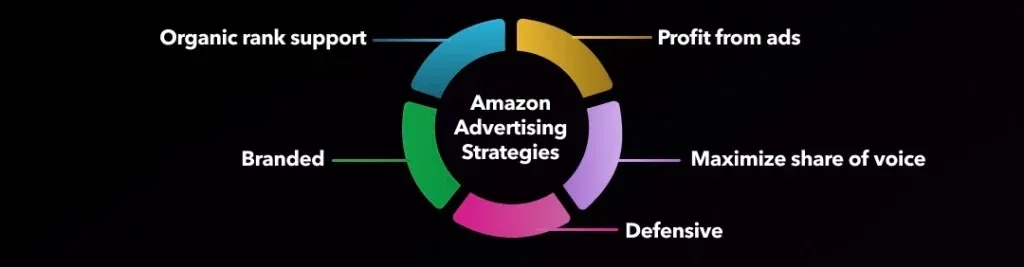
Before launching a campaign, clarify the objective. Amazon PPC has five distinct strategic directions. Each one serves a different function in your business growth model.
There are five core Amazon PPC strategies every seller should understand:
Objective: Improve organic rankings through controlled PPC.
When you’re launching a product or trying to gain traction for a lower-ranked SKU, this is the strategy to use. You aren’t aiming to profit directly from ads—you’re using ads to drive traffic, conversions, and ultimately organic lift.
Execution Details:
Track Organic Rank Movement alongside TACoS over time.
Prioritize converting keywords that you want to rank for organically.
ACoS can be higher here—profit isn’t the goal. Just don’t let it spiral.
Gradually reduce ad spend once organic rank improves to see if sales hold.
Example:
You’re launching a new supplement. You choose 10 primary keywords based on search volume and relevance, run aggressive SP Exact Match ads to drive velocity, and monitor keyword rank via Helium 10 or Data Dive weekly. As your rank climbs, you begin trimming bids and reallocating toward profitability-focused campaigns.
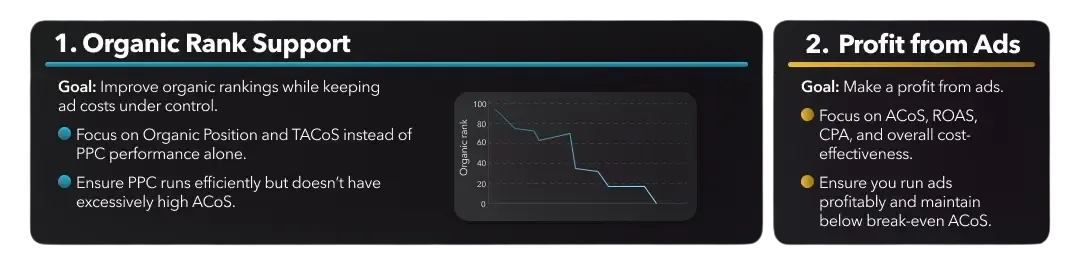
Objective: Direct ROI. Every dollar spent must convert into profitable revenue.
This is where you scale ads based on performance. Think of this like a performance marketing campaign—strict metrics, clean execution.
Execution Details:
Set hard ACoS targets based on product margins.
Use Exact Match and Phrase Match to limit wasted spend.
Consider campaign negation strategies (especially in Broad Match).
Focus on campaigns with consistent CTR > 0.5% and CVR > 10%.
KPIs:
ACoS vs. Target ACoS
ROAS
CPA
Break-even ACoS
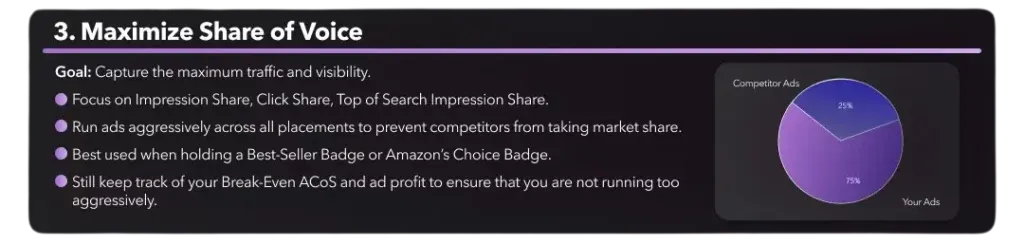
Objective: Capture as much ad real estate as possible.
This strategy is best used when you’re already dominating a category or hold competitive advantage (like Amazon’s Choice, Bestseller, or high review volume).
Execution Details:
Target Top of Search across all relevant keywords.
Run Sponsored Products, Brands, and Display together.
Bid aggressively, especially on competitor brand terms.
Monitor Top of Search Impression Share and Click Share weekly.
Adjust budgets dynamically based on competitive positioning.
Important:
Don’t use this unless your Break-Even ACoS is healthy—overspending here without defensible unit economics can destroy margin fast.

Objective: Prevent competitors from stealing traffic on your PDPs or brand terms.
Sellers often ignore defense, assuming a shopper on their product page will convert. But your PDP is ad real estate for competitors too—and if you don’t occupy it, they will.
Execution Details:
Target your own ASINs via Sponsored Display and Product Targeting.
Run branded keyword campaigns using SP Exact and SB.
Use strong creatives: social proof, trust elements, and UGC-style images.
Pro Tip:
Use cross-ASIN targeting to drive traffic from lower-priced SKUs to higher-margin bundles or upsell items.
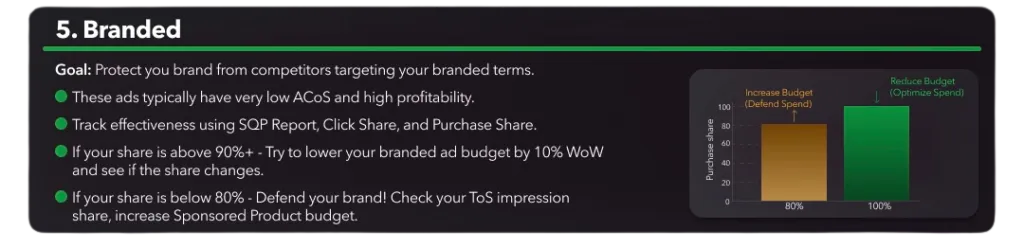
Objective: Capture traffic from branded search terms with maximum efficiency.
Branded terms convert well. You need to own them, period. They’re cheap, profitable, and easy to manage.
Execution Details:
Monitor Search Query Performance (SQP) data weekly.
Set up separate branded campaigns for clearer performance tracking.
Track branded share of voice. If it dips below 80%, increase budget or review creative.
Branded ads should generally have ACoS <10%.
Optimization Tactic:
If CTR drops on branded campaigns, refresh creative, test new headline copy, or test Sponsored Brands Video.
Amazon PPC campaigns operate under two primary structures: Automatic and Manual. Within Manual, there are multiple match types that determine how broad or narrow your targeting is.
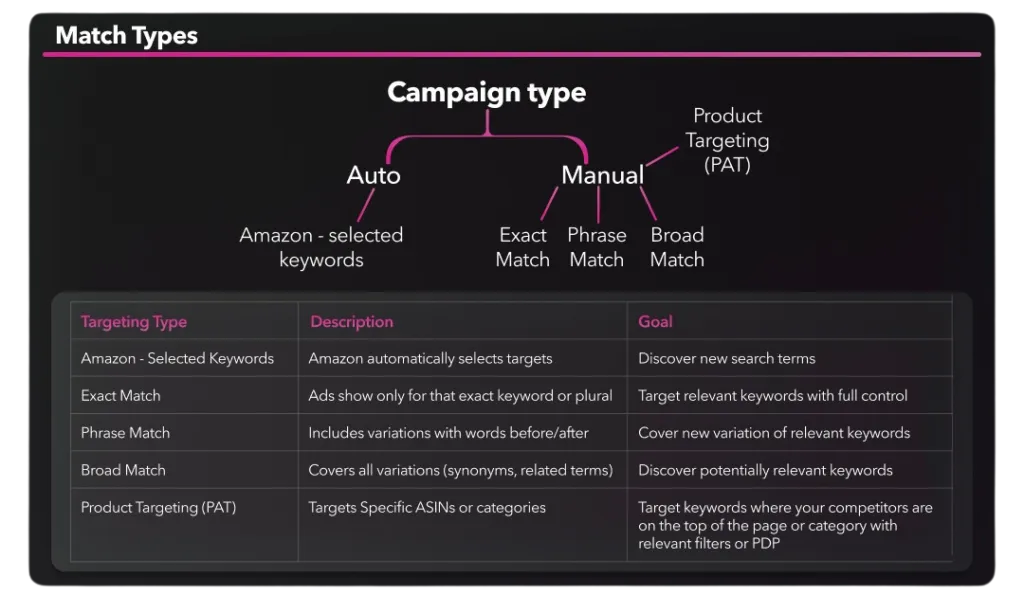
Purpose: Automatic campaigns are primarily used to uncover new and relevant keywords and product targets that customers are using to find products similar to yours. Since you don’t choose the keywords manually, Amazon uses its own algorithm to match your ads with search terms and related product pages.
How It Works: You don’t select the specific keywords or ASINs to target. Instead, Amazon automatically determines where your ads will appear based on your product listing details (title, description, backend keywords, etc.). This makes it easy to get started, especially for new products or sellers unfamiliar with keyword research.
Optimization Strategy: Monitor and Harvest Regularly analyze performance data from your automatic campaigns to identify:
High-performing search terms (those with good click-through and conversion rates)
Irrelevant or low-performing terms (to add as negative keywords)
Use Case:
New product launch, identifying long-tail keyword opportunities.
What It Does: Targets only the specific keyword or very close variants (e.g., plural or misspellings). Ads will only show when shoppers search for that exact term with minimal variation.
Best For: Campaigns focused on performance optimization, profitability, and scaling known winners. Ideal when you’ve already discovered high-converting keywords through automatic or broad match campaigns.
What It Does: Targets search queries that include your exact keyword phrase in the same word order, but with other words before or after it. For example, targeting “running shoes” may trigger ads for “men’s running shoes” or “running shoes for women.”
Best For: Useful in both launch and scaling phases. Good for testing and expanding keyword variations while still maintaining relevance.
What It Does: Triggers ads for searches containing your keyword in any order, along with related terms, synonyms, or variations. For example, “running shoes” might match with “athletic sneakers” or “jogging footwear.”
Best For: Early-stage campaigns or when testing new keyword ideas. Make sure to limit the budget and regularly review search term reports to cut out irrelevant matches with negative keywords.
What It Does: Allows you to target specific ASINs (competitor or your own products) or broader product categories. Your ads will appear on product detail pages or in the “sponsored products related to this item” section.
Best For:
Cross-selling or upselling your own products
Capturing competitor traffic
Boosting visibility within category listings
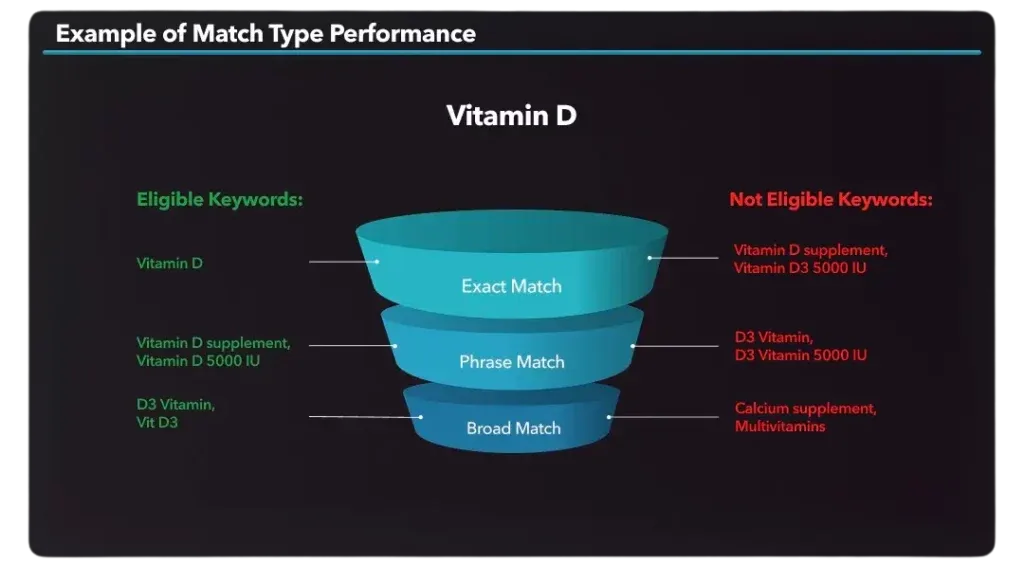
Exact Match: “Vitamin D” → High intent, narrow volume.
Phrase Match: “Vitamin D supplement 5000 IU” → Mid-volume, targeted.
Broad Match: “D3 vitamins”, “vitamin for immunity” → Large volume, low intent.
PAT: Competing with similar supplements directly on PDPs.
Amazon PPC includes three core ad formats:
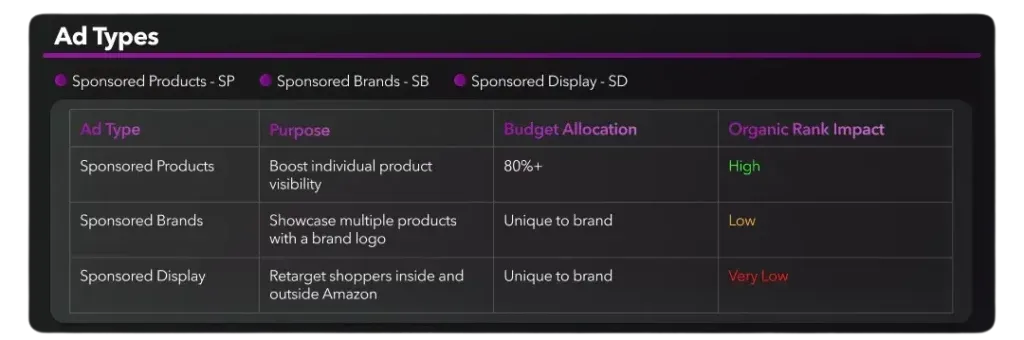
Tactical Breakdown:
Use SP for launches, ranking, profitability.
Use SB to lift multiple SKUs or for branded domination.
Use SD to defend your PDPs or re-engage outside Amazon.
Creative Tip:
Sponsored Brand Videos perform well in mobile. Use concise messaging and highlight a key benefit in the first 3 seconds.
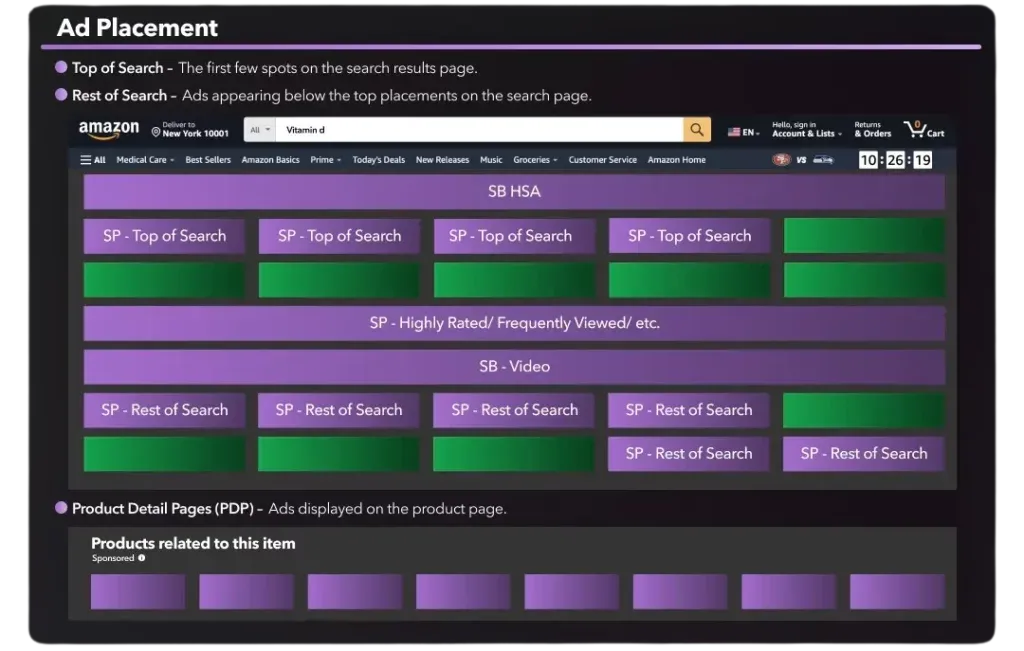
Highest conversion and CTR - These placements often drive the most traffic and sales due to their visibility at the very top of search results.
Use for branded, SOV, and organic rank strategies - Ideal for campaigns focused on brand visibility, increasing share of voice (SOV), and boosting organic ranking through high-volume keyword targeting.
Cheaper CPCs - These placements typically have lower competition, resulting in reduced cost-per-click while still reaching shoppers with search intent.
Use for long-tail testing and supporting campaigns - Great for testing niche or long-tail keywords and for supplementing main campaigns with broader reach at a lower cost.
Use for defense or targeting competitor ASINs - Target your own ASINs to block competitors (defense) or target competitor listings to win over their traffic.
Combine with competitive pricing and strong social proof - Since shoppers are already comparing products, make sure your offer stands out with sharp pricing, good reviews, and high-quality content.
Metrics must align with your campaign objective. Here’s what to track:

ACoS = Ad Spend / Ad Sales → Shows how much you’re spending on ads to generate each dollar of ad revenue — lower is generally better.
TACoS = Ad Spend / Total Sales → Reflects how advertising impacts your entire business, not just ad-attributed sales — useful for measuring long-term growth.
ROAS = Revenue / Ad Spend → The inverse of ACoS — higher ROAS means better return on your advertising investment.
CPA = Ad Spend / Number of Orders → Indicates how much it costs to acquire one customer order through ads.
CPC = Ad Spend / Clicks → Tells you the average cost of each click on your ad — useful for understanding competitiveness and bidding strategy.
CTR = Clicks / Impressions → Measures how often people click on your ad when they see it — a key indicator of ad relevance and appeal.
CVR = Orders / Clicks → Tells you how many of those clicks actually led to a purchase — a direct measure of listing effectiveness and buyer intent.
Segment your campaigns by goal (profit, rank, brand defense).
Use match types intentionally, not randomly.
Monitor metrics weekly — automate with tools like My Real Profit for visibility.
Defend your brand terms always. They’re your cheapest, most efficient traffic source.
Use ToS placements strategically, not universally. Top of Search burns budget if conversion doesn’t back it up.
Always track TACoS to ensure ad spend drives overall growth—not just ad-attributed revenue.
Amazon PPC isn’t one-size-fits-all. Your campaign structure should reflect your business goals at a SKU level. This requires discipline in targeting, thoughtful use of placements, clear measurement practices, and strategic allocation of budget across ad types and funnel stages.
If you’re serious about profit, growth, and brand control on Amazon, strategy is non-negotiable.
That’s exactly why we built Real Profit — to give sellers like you the visibility, clarity, and tools needed to run data-backed, profit-focused PPC campaigns.
Try My Real Profit for free and start making the most out of your Amazon data today!